
When a teacher moves to page 12, the important question is not whether a message was sent. The important question is whether every participant converges on the same lesson state after delay, duplication, reordering, or reconnect.
This article focuses on the classroom interaction protocol: regional WebSocket nodes, message ordering, deduplication, route fallback, and snapshot recovery.
Page changes, annotations, and praise events do not share the same recovery policy. A page state may be replaced by a newer snapshot; a stroke may need all segments; a short animation may be safe to drop after its context has passed.
The media provider is part of the surrounding classroom, but it is not the subject here. The goal is to make interaction state converge even when delivery is delayed, duplicated, or interrupted.
Start with What the Classroom Needs to Preserve
A page change, a pen stroke, and a praise animation can share a connection, but they should not share the same recovery policy.
For page changes, the useful instruction is “display page 12,” rather than “move forward one page.” Repeating an absolute state update does not move the student to page 13. However, absolute page numbers alone do not solve reordering: an older instruction for page 11 could arrive afterward.
The message therefore needs the courseware identifier, its version, the target page, and an ordering value for the teacher’s control stream. The client applies a newer valid state and ignores an older one. Page numbers themselves cannot serve as versions because a teacher may intentionally move backward.
Courseware should also be loaded independently of control messages. Fast message delivery achieves little if the student must then wait for a large slide image to download.
Drawing introduces a different problem. Sending the teacher’s screen coordinates will produce misplaced marks on a student’s smaller display. Coordinates should be relative to the courseware content area, accounting for scaling and any surrounding margins. A stroke also needs its page, identifier, color, and width.
During drawing, several sampled points can travel together. This reduces message overhead, but the batching interval becomes part of the visible delay. It needs testing on the devices and networks students actually use.
The live preview and the final stroke deserve separate treatment. A preview can tolerate reduced sampling under pressure; a completed annotation should remain recoverable. Stroke identifiers and segment indexes allow the receiver to assemble segments, detect gaps, and retrieve the completed stroke when necessary.
Praise is closer to a short-lived event. A small message identifies the recipient and the animation to play; the animation assets can already be on the device. Retries must reuse the same event identifier so the client does not celebrate one teacher action twice.
If the student reconnects much later, replaying every missed animation would interrupt the current lesson. Those effects can expire. If praise also awards points, however, the points need durable, idempotent processing. An expired animation must not silently cancel an earned reward.
These differences give the protocol its shape: page changes preserve current state, annotations preserve meaningful content, and praise preserves a timely interaction without unnecessary repetition.
Connect Locally and Route by Classroom Membership
For a browser client, the persistent connection can be WSS: WebSocket protected by TLS. The connection framework handles transport concerns such as heartbeats and writes, while the application handles classroom membership, permissions, and message interpretation.
Framework selection should consider more than the maximum number of open connections. A slow student must not block delivery to another classroom, outgoing buffers need limits, and a node leaving service should support controlled connection recovery.
“Nearby” also needs a network definition. Geographic distance is a useful starting point, but route quality, node health, and capacity matter. A scheduling service can return candidate endpoints for the client to probe. Once a connection works well, a brief fluctuation should not trigger repeated migration: reconnecting also means authenticating, rejoining, and recovering state.
Each access node maintains its own mapping between users, device sessions, classrooms, and connections. The wider system needs enough membership information to locate a classroom’s participants; it does not need a global copy of every connection object.
A separate classroom authority determines who can control the lesson. The server must validate membership and permissions rather than trust a client field claiming that the sender is the teacher.
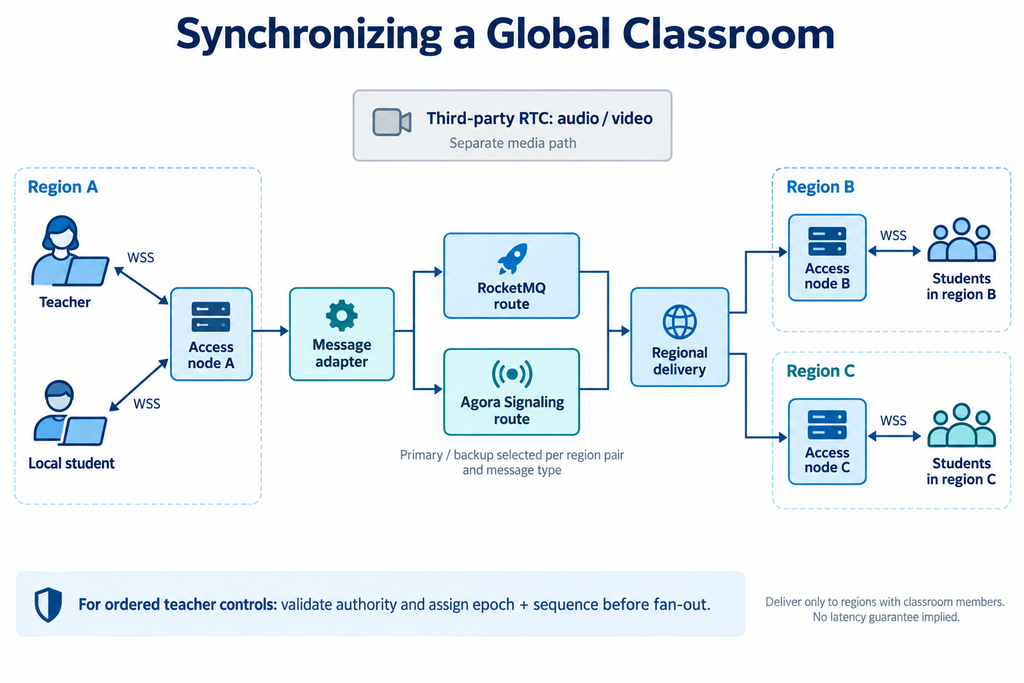
Figure 1. Participants connect to regional access nodes. Classroom messages use a shared protocol across alternative transport routes, while audio and video follow a separate media path.
For ordered teacher controls, authorization and ordering must happen before both local and remote distribution. Otherwise, students attached to the teacher’s node could apply an uncommitted control change while remote students receive a different accepted order.
Once accepted, an event can reach local participants directly and remote participants through the transport adapter. The diagram shows the teacher-to-student direction; authorized student interactions follow the same general path with a different recipient scope.
One-to-one and small-group lessons therefore need different routing targets, rather than entirely different messaging systems. A praise event may target one student or the whole class, depending on the intended experience.
At a small scale, broadcasting to every node and filtering locally is straightforward. As the system grows, sending every pen movement to regions with no members of that classroom becomes wasteful. Classroom membership can instead drive regional subscriptions, followed by local delivery to the relevant access nodes.
The broker’s subscription semantics must match this topology. A load-balanced consumer group generally distributes work among consumers; it does not automatically give every Socket node a copy. One practical arrangement is a regional receiving service that consumes events and forwards them to the appropriate local nodes. Received remote events must not be published back into the global route, creating a broadcast loop.
Keeping our own interaction protocol has value because classroom permissions, recipient selection, state recovery, and provider switching remain under application control. It also creates operational work. If a managed classroom or whiteboard product already provides the required behavior, a custom layer needs a clear reason to exist.
Make Two Routes Carry One Business Operation
The transport adapter should accept a common classroom message and translate it into the selected provider’s publishing and subscription model. Switching the server-side route can then happen without forcing every student to reconnect.
The Agora route here means a signaling transport, separate from the RTC media stream. Agora describes Signaling as supporting metadata synchronization, event notifications, and stream channels. That makes it a candidate for this role, but the selected SDK still needs to support the required server-side integration and traffic pattern. Agora Signaling
The RocketMQ route needs equally precise qualification. “Global RocketMQ” is an architectural shorthand, not a guarantee that every region pair supports interactive drawing latency. Alibaba Cloud’s Global Message Replication documentation describes cross-region replication with seconds-level latency. A route with that behavior may support recovery or delay-tolerant events, but I would not put it on a live handwriting path without validating a different deployment that meets the interaction budget. Alibaba Cloud Global Message Replication
Primary and backup roles should consequently depend on the region pair and message type. A slower backup may preserve the current page while delivering a visibly degraded drawing experience. That is still useful recovery, but it should be understood as degraded service.
Two providers can also share failure points, including the access node or the student’s final network connection. Route diversity reduces some risks; it does not remove every dependency.
The protocol needs identifiers with distinct responsibilities:
| Field | Responsibility |
|---|---|
messageId | Identifies one operation across retries and transport routes. |
classroomId | Determines the classroom routing scope. |
lessonEpoch | Identifies the current accepted lesson or control generation. |
sequence | Orders updates within a defined stream, such as teacher page controls. |
strokeId and segmentIndex | Identify and assemble parts of an annotation. |
A message identifier answers whether an operation has already been received. It does not establish which page change is newer. An ordering value answers that question only within its defined scope.
For teacher controls, a classroom authority can assign increasing sequence values within an epoch. A teacher handover or authority failover needs coordinated ownership and a new accepted epoch where appropriate. Access nodes must not independently declare themselves authoritative during a network partition.
There is no need to force every student’s pen sample through that same global sequence. Stroke-local ordering can be sufficient for reconstructing independent annotations.
Failover must also handle uncertainty. The primary route may accept a message and then deliver it slowly. A missing acknowledgment does not prove that nothing happened.
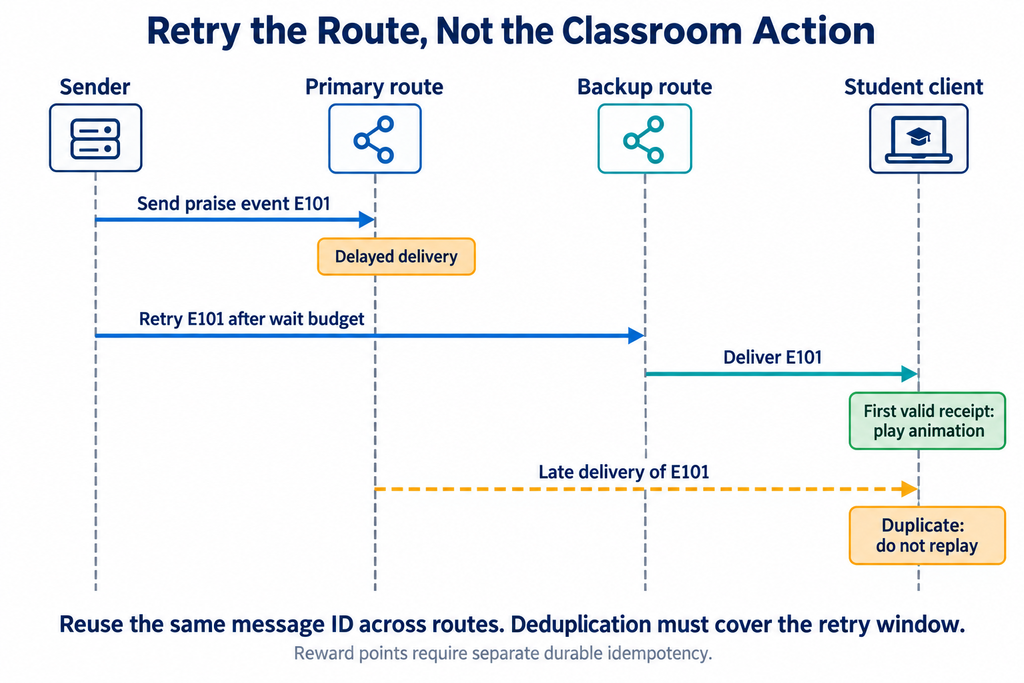
Figure 2. Event E101 reaches the student through the backup route first. Its late primary-route copy remains the same operation and must not trigger a second animation.
A retry therefore keeps the original messageId. Regional receivers can suppress duplicate forwarding, while clients protect against duplicate application. The deduplication retention period must cover the allowed retry and replay window. An in-memory cache that disappears on reconnect is insufficient if the system may replay older events afterward.
For durable rewards, duplicate prevention belongs in the business transaction as well. The same distinction appears in reliable messaging for payment events and reward points: receiving a message again must not repeat its financial or reward effect.
Route health should include target-region receipts, queueing behavior, and relevant client acknowledgments, rather than only publishing errors. Sustained deterioration can trigger a route change, followed by a recovery observation period before switching back. The backup also needs active subscriptions and available capacity before an incident starts.
Test an Out-of-Order Classroom Update
Use two regional consumers and one lesson epoch in staging. Hold one event in transit, deliver a newer event first, and then release the delayed copy. The example payload is deliberately small so the result can be inspected in a client log.
{
  "messageId": "lesson-1042-page-12",
  "classroomId": "class-1042",
  "lessonEpoch": 7,
  "sequence": 42,
  "type": "PAGE_CHANGED",
  "page": 12
}| Step | Injected condition | Expected state |
|---|---|---|
| 1 | Hold sequence 42 at region A. | The client remains on the previous page. |
| 2 | Deliver sequence 43 through region B. | The client applies the newer page state. |
| 3 | Release sequence 42 late. | The older event is ignored and cannot revert the page. |
| 4 | Deliver sequence 43 again over the backup route. | The same message ID is applied once. |
| 5 | Reconnect with a snapshot position. | Current page and annotation state are restored before live delivery continues. |
Record messageId, lesson epoch, sequence, route, and the client apply result. A route receipt is not proof that the student rendered the event. The test passes only when the final visible state is correct and the late or duplicate deliveries leave no second effect.
Reconnect to the Current Lesson
Students change networks, put devices into the background, and occasionally lose their connection when a server restarts. Reconnection is therefore part of the normal protocol.
A new connection must authenticate and rejoin the classroom. Cleanup for the old connection should compare connection or session identifiers so a delayed close event cannot remove the newly established session.
The next step is state recovery. Replaying every historical action is usually the wrong experience: a returning student needs the current courseware, current page, and relevant annotations.
A snapshot can provide that state together with a corresponding event position. The position must describe the same logical point as the snapshot. Combining a page captured before an update with a cursor captured after it could cause the client to skip the update permanently.
The transition from snapshot to live events also needs to close the gap. One approach is to begin buffering incoming events, retrieve the snapshot and its position, discard buffered events already represented in it, and then apply the remaining relevant updates before continuing live.
For page state, several missed changes can collapse into the current page. For annotations, the client may need missing segments or a completed stroke. An expired praise animation can be skipped. If required history has already left the retention window, the client should obtain a fresh snapshot instead of waiting indefinitely.
Acknowledgments need similarly explicit meaning. An access node receiving a message, a provider accepting it, a destination node writing it to a connection, and a client applying it are different milestones. None automatically proves durable storage.
If the application promises to restore an annotation after node failure, its acknowledgment policy must align with the chosen durable storage boundary. If it only forwards a preview in memory, recovery has to come from a later completed stroke or another authoritative source.
Measure the Moment the Student Can See
The full interaction delay includes client sampling, batching, the connection to the access node, authorization and ordering, server queues, cross-region transport, Socket delivery, and rendering.
Timing only the provider’s send call leaves much of that path invisible. A fast route cannot compensate for an unloaded slide or a device struggling to render accumulated drawing events.
Audio, video, and interactions also travel independently. Acceptable live latency does not imply precise synchronization between them. A recording that must align speech and annotations needs an additional shared timeline and playback design.
For observation, a message identifier can connect traces across the classroom path. Useful measurements include tail latency by region and network combination, retransmissions, duplicate suppression, and reconnection recovery time.
Client clocks require care. Subtracting a timestamp from one device from a timestamp on another can produce misleading one-way latency. Clock uncertainty needs to be accounted for; acknowledgment round trips and measurements using a single machine’s monotonic clock provide complementary evidence.
Small-group lessons introduce another practical concern: one student may fall behind while everyone else remains healthy. Each connection needs a bounded outgoing queue. Superseded page states can collapse into the newest valid state, drawing previews can use fewer points, and completed annotations remain recoverable.
Allowing a backlog to grow indefinitely preserves old messages at the expense of the current lesson. A praise animation delivered long after its context has passed may be technically received but educationally useless.
The failure cases worth exercising follow directly from these semantics: a primary route that slows without disconnecting, a lost acknowledgment, a late duplicate after backup delivery, a teacher handover, and a student reconnecting to another region. The expected outcomes should be visible: the correct page, complete annotations, and no repeated praise effect.
A team with sufficient networking expertise could introduce its own inter-region transport behind the same adapter. That brings responsibility for routing, congestion, capacity, and fault isolation. It also leaves geographic propagation distance and the student’s access network in place. Its value has to come from measured improvement on the paths that matter.
What stays with me from this project is that a classroom is synchronized only when participants can continue the same activity together. Regional connections bring the service closer to them. Cross-node routing reaches the right classmates. Alternative transports provide recovery options. Message identity, ordering, and state restoration determine whether those pieces still behave like one classroom when delivery becomes imperfect.
Audio and video let the teacher and students communicate. The interaction layer keeps them working on the same lesson.
For media and courseware failover boundaries, see Online Classroom High Availability: Media Failover and Courseware Fallback. For Redis pressure, ClickHouse metrics, and post-class archival evidence, see Beyond Uptime: Monitoring Redis Pressure and the Online Classroom Experience.