

A payment appears to have succeeded before its order was created.
That is what the logs suggest. The order service records creation at 10:00:00.500, while the payment service records a successful payment at 10:00:00.200. The timestamps look wrong, but the business workflow may have executed correctly: the payment service processed an order that already existed.
The services simply disagreed about the time.
This becomes important when timestamps do more than help people read logs. An application might use them to decide which update wins, whether an order has expired, or which event a consumer should apply next. A small clock difference can then become a business error.
An order workflow provides a useful way to separate these concerns. Recording when an order was created, measuring a payment-provider call, generating an order ID, and deciding whether a payment can change an order’s state are different problems. Physical clocks, monotonic clocks, Snowflake IDs, and logical clocks help with different parts of that workflow.
The examples below illustrate design choices rather than measured production incidents.
Reproduce the skew with a deterministic Java test
The opening example is deliberately synthetic. A unit test can reproduce the inversion without pretending that it came from a production incident:
import java.time.Clock;
import java.time.Instant;
import java.time.ZoneOffset;

Clock orderClock = Clock.fixed(
    Instant.parse("2026-09-09T10:00:00.500Z"), ZoneOffset.UTC);
Clock paymentClock = Clock.fixed(
    Instant.parse("2026-09-09T10:00:00.200Z"), ZoneOffset.UTC);

Instant orderCreatedAt = Instant.now(orderClock);
Instant paymentAcceptedAt = Instant.now(paymentClock);

assert paymentAcceptedAt.isBefore(orderCreatedAt);
The assertion is true because the two services use different fixed clocks. It demonstrates why a timestamp comparison cannot prove the order of a message or transaction. In production code, inject a Clock into the service and reserve Clock.fixed for tests; the Java Clock API documents that contract.
Use calendar time for records and monotonic time for durations
Clock adjustments are possible even on a single machine. Distributed systems add another complication: separate machines can have different errors at the same moment.
Wall-clock time connects an event to a calendar. In Java, Instant.now() represents a point on that timeline. A LocalDateTime represents local calendar fields without an offset or time zone, so it needs additional context before it identifies an unambiguous instant.
These representations are useful for audit records and business timestamps. They do not guarantee that consecutive readings always increase.
Servers synchronize their clocks because hardware clocks drift. Depending on the environment and configuration, corrections may be gradual or may produce a visible jump. Manual changes can also move the clock. Code that subtracts two wall-clock readings can therefore report an unexpected duration.
For elapsed time within one JVM, use a monotonic time source:
long startedAt = System.nanoTime();

callPaymentProvider();

long elapsedNanos = System.nanoTime() - startedAt;
The returned value has an arbitrary origin. It should not be stored as an order creation timestamp or compared with a value generated by another JVM. Its purpose is measuring elapsed time within the same running JVM, as described in the official System.nanoTime() documentation.
An order that expires after thirty minutes needs a different design. Its deadline must survive a restart, so a process-local monotonic reading is not enough. Store a durable business deadline, define which service evaluates it, and make expiration a controlled state transition.
That last step matters when payment confirmation races with cancellation. Both handlers might attempt to change an order from AWAITING_PAYMENT, but only one transition should succeed under the chosen business rules. A delayed payment confirmation for an already closed order then needs an explicit resolution path, such as reconciliation or refund processing.
UPDATE orders
SET status = 'PAID', version = version + 1
WHERE id = :orderId
  AND status = 'AWAITING_PAYMENT'
  AND version = :expectedVersion;
The conditional update makes the accepted revision explicit. If the row no longer matches, the handler reloads the order and applies the late-payment policy instead of letting a newer timestamp overwrite the state.
The policy must also define whether “paid before the deadline” means provider acceptance time, local receipt time, or another authoritative event. Comparing timestamps from two application logs cannot make that decision reliably.
An identifier is not a business sequence
Snowflake-style identifiers combine a timestamp component, a worker identifier, and a sequence within a time interval. This makes them useful when multiple nodes need to generate identifiers without contacting a central allocator for every request.
Their familiar roughly increasing shape can encourage an unsafe shortcut: treating a larger ID as proof that one business event happened after another.
Even when identifiers are unique, clock differences between workers prevent that conclusion. Identifier allocation can also occur before a transaction commits. One request may obtain an ID first and commit later than another.
Clock rollback creates a separate risk. If a worker revisits a timestamp interval and repeats a sequence under the same worker identifier, it may reuse an identifier combination. Implementations commonly detect backward movement and apply a policy such as bounded waiting or refusing generation.
However, checking the previous timestamp in memory is only part of the solution. Worker identities must be allocated safely, and restart behavior must prevent unsafe reuse of a previous worker’s identifier space. Switching to another worker ID is useful only when that identity is genuinely available.
For the order workflow, an order ID answers “which order?” A business version answers “which accepted revision of this order?” Keep those responsibilities separate.
An authoritative order writer can advance a version in the same database transaction as a state change. If several writers are allowed, they need a concurrency mechanism that serializes accepted revisions. Replacing that mechanism with a timestamp or a Snowflake ID does not provide equivalent protection.
Follow causal relationships rather than sorting nearby timestamps
Suppose the order service commits an order and publishes an event. The payment service receives that event and begins processing it.
There is an observable dependency: the order is committed before the event is sent, the event is sent before it is received, and receipt precedes the processing that depends on it. Clock skew cannot reverse that dependency.
Lamport’s happened-before relation captures this idea through three rules: events are ordered within a process, sending a message precedes receiving that message, and those relationships are transitive.
A Lamport clock assigns increasing logical values consistent with that relation. Local events advance the counter; a receive event advances beyond both the local value and the value carried by the message.
For example, suppose an outgoing order event carries logical time 6. The payment service’s counter is 3. On receipt, it computes max(3, 6) + 1 = 7. Its next local event advances the counter to 8.
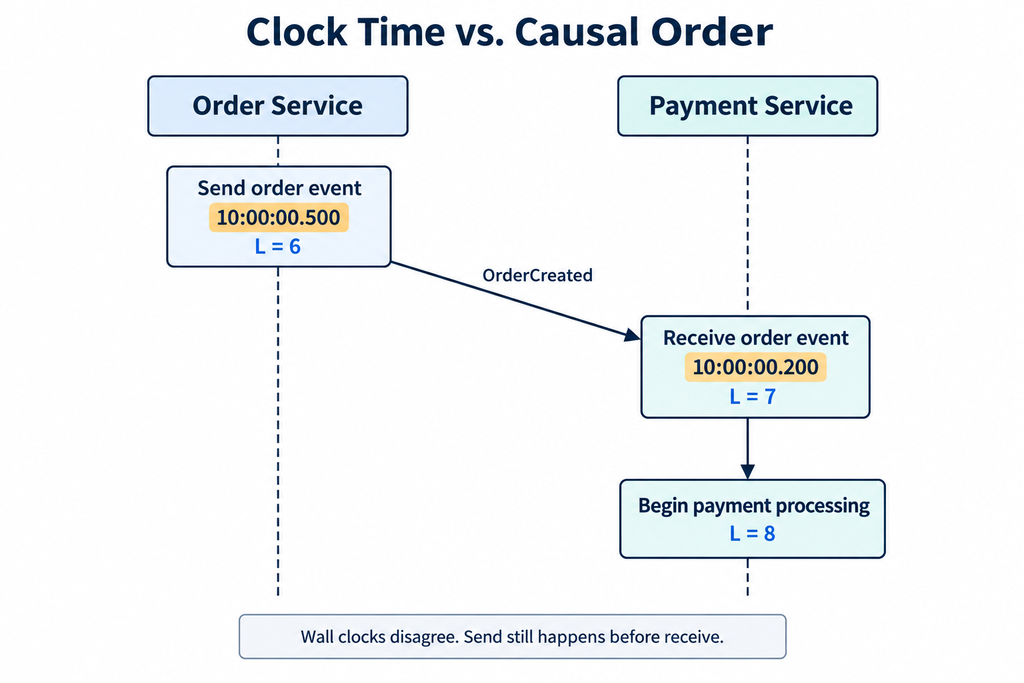
Figure 1. The receive timestamp is numerically smaller than the send timestamp, but the message dependency still establishes their causal order.
The event boundaries must be applied consistently. In this example, sending is the event labeled 6; if creation and sending are modeled as separate local events, each advances the counter.
The important guarantee is:
A happened-before B ⇒ L(A) < L(B)The reverse implication does not hold. Two unrelated events can have logical values 10 and 15 without either depending on the other. Lamport timestamps preserve causal order, but they do not fully identify concurrency.
Adding a node identifier as a tie-breaker can give events a deterministic total ordering. That still does not make consumers execute in that order. A consumer may receive a larger timestamp while a smaller one is delayed in the network. Reliable ordered execution requires a delivery or coordination protocol in addition to comparable labels.
This distinction is useful during debugging. A timestamp helps place an event on an approximate timeline; an event identifier, parent relationship, and order version help explain why it occurred. Chronological sorting alone cannot reconstruct every dependency.
Detecting concurrent changes does not decide how to merge them
Some workflows need to distinguish “this update followed that one” from “these updates were made independently.”
Imagine two disconnected operators editing the same delivery note. One enters “deliver in the afternoon,” while another enters “call before arrival.” Selecting the entry with the larger server timestamp may silently discard useful information.
Vector clocks track more causal information. In a simplified system with participants A, B, and C, each event carries a vector with one counter per participant.
Starting from [0,0,0], A performs an event and reaches [1,0,0]. Independently, B performs an event and reaches [0,1,0]. Neither vector is component-wise less than or equal to the other, so the events are concurrent in this model.
If B then receives A’s vector, it takes the component-wise maximum, producing [1,1,0], and increments its own component to produce [1,2,0].
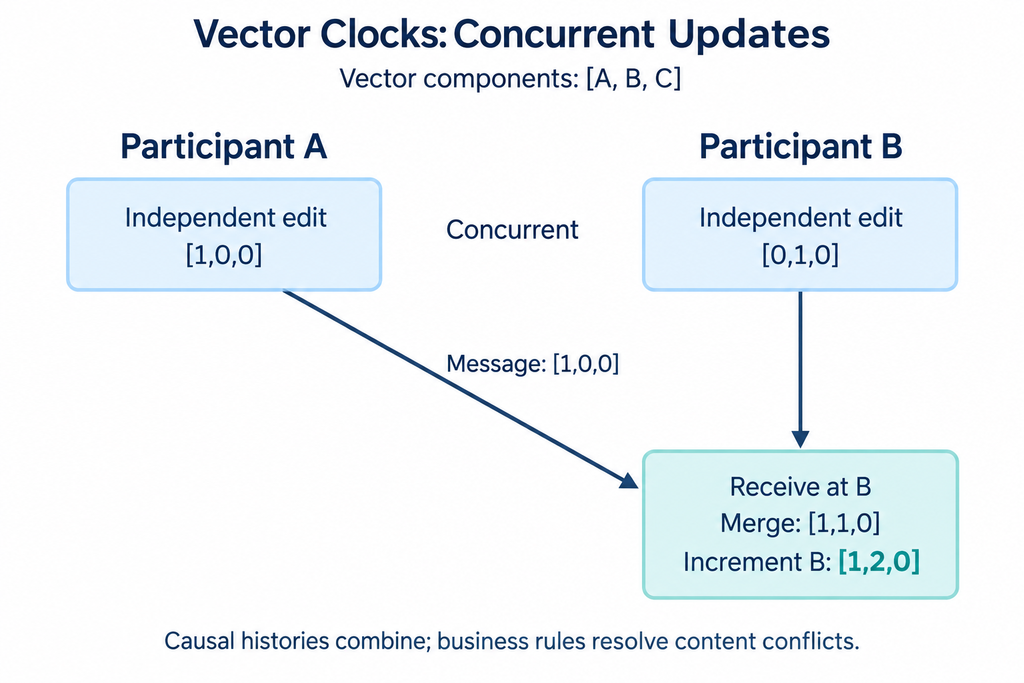
Figure 2. The receive event at B includes both histories. The illustration treats A’s edit and outgoing notification as one modeled event; a separately modeled send event would advance A’s counter again.
This helps the application preserve concurrent versions instead of pretending that one causally replaced the other. It does not choose the correct merged value. The two delivery instructions might be combined, while two different delivery addresses may require user confirmation.
For a service with one authoritative database write path, a conventional version check may already solve the practical editing problem: reject an update based on an outdated version and ask the editor to reload or merge. Vector clocks become more relevant when independent writers must operate without that shared serialization point.
Their cost follows the participant model. More tracked writers mean more metadata, while changing membership and pruning history complicate interpretation. The ability to detect concurrency is valuable when the business uses it; it is unnecessary overhead when all accepted changes already pass through one controlled writer.
Hybrid Logical Clocks address a different requirement. They combine a physical-time-related component with a logical counter, retaining a useful relationship to calendar time while advancing consistently with communicated causal information.
HLCs do not provide the full concurrency information of vector clocks. They also do not resolve conflicting edits, enforce state transitions, or make physical clocks accurate. Their relationship to real time depends on clock behavior and the assumptions of the implementation.
For the order service, adopting HLC would therefore need a concrete reason—for example, integration with a storage system that already uses it. It would not replace the order version or the rules governing payment and cancellation.
Order the workflow at the boundary that matters
Most order systems need a consistent history for each order. They rarely need to decide whether a payment for order A globally preceded a shipment for unrelated order B by two milliseconds.
This is the useful boundary for serialization. Events belonging to one order can be routed through the same ordered stream or partition, while unrelated orders proceed independently.
Partitioning is only part of the contract. It preserves the stream’s defined order under its delivery rules; it does not automatically establish the correct business order across independent producers. Concurrent consumer processing, retries, and asynchronous side effects can also change completion order.
A more explicit order event might contain:
{
  "eventId": "example-event-1042-12",
  "orderId": 1042,
  "orderVersion": 12,
  "eventType": "OrderPaid",
  "occurredAt": "2026-09-09T10:00:00Z"
}
Each field has a job. eventId identifies a delivery for deduplication. orderVersion identifies a revision assigned by the authoritative order write path. occurredAt supports business reporting and investigation; it is not the sole authority for applying the transition.
Suppose a consumer has applied version 10 and receives version 12. If its contract includes every consecutive order revision, it has detected a gap. It may wait for version 11, retrieve missing history, or reload authoritative state before continuing.
That assumption must be explicit. A consumer subscribed only to selected event types cannot assume every numerical gap is a lost message. Likewise, a consumer that replaces a complete projection from a newer snapshot has different requirements from one that executes every transition or external effect.
Repeated delivery needs a separate rule. Reprocessing OrderPaid must not award points twice. A durable uniqueness constraint on the reward operation protects that effect; an ordered partition alone does not.
The same reasoning applies to a late payment after cancellation. A newer timestamp does not authorize changing CANCELLED to PAID. The state machine must decide whether to reject the transition, reconcile payment status, or initiate another business action.
For an implementation review, write the contract as three separate rows:
| Concern | Suitable mechanism |
|---|---|
| Identify a record or event | Unique identifier |
| Order accepted changes to one business object | Authoritative revision or sequence |
| Prevent invalid or repeated effects | State conditions, transactions, and idempotency |
Implementation checklist
- Persist an unambiguous UTC instant for audit and business records.
- Measure local durations with
System.nanoTime(); never use it as a cross-process timestamp. - Advance an order version in the same transaction as the accepted state change.
- Use an event ID for deduplication and a version for business progression.
- Define the late-payment, retry, and missing-version paths before choosing a clock.
Global coordination becomes necessary when a business invariant genuinely crosses those boundaries. Even then, the goal should be to coordinate the relevant operation, not impose one sequence on every login, page view, payment, and inventory update in the platform.
For a Java order service, I would use calendar timestamps for durable business records, monotonic time for local duration measurement, and explicit order versions for state progression. Message relationships would help explain causality, while database conditions and idempotency would protect the effects of retries.
Logical clocks deepen the understanding of what those mechanisms can prove. Their practical value is knowing when a timestamp is sufficient, when a causal relationship matters, and when the application needs an authoritative decision that no clock can make for it.