

An order service can become unavailable even when its own code and database are working normally. A payment dependency slows down, outgoing calls remain active longer, and incoming requests begin to accumulate. If callers retry while the original attempts are still running, the system creates additional work precisely when it has the least capacity to handle it.
The question here is narrower: how many calls may wait, what happens to a call that was already sent, and which result can the order state safely expose when payment is slow?
The reference workflow depends on inventory and payment services; recommendations are optional. All timing and traffic figures below are illustrative, so they show what to measure rather than claiming a production benchmark. Sentinel is the concrete Java example, but the boundaries apply to other resilience libraries too.
A Slow Dependency Can Exhaust an Otherwise Healthy Service
Consider a synchronous payment call that normally completes in around 100 milliseconds. If the dependency begins taking five seconds, the order service’s worker thread may remain blocked for that entire wait.
The incoming request rate does not need to increase for this to become dangerous. At an illustrative rate of 200 calls per second, an average duration of 0.1 seconds corresponds to roughly 20 calls in flight. At an average duration of five seconds, the same calculation produces roughly 1,000.
This is an average-load estimate under steady conditions, assuming requests are admitted and not cut short by earlier timeouts. It is not a prediction that a service with a finite thread pool will successfully sustain that workload. In practice, queues, rejection, and timeouts intervene.
The calculation explains why QPS alone is an incomplete description of pressure. The service is doing the same kind of work, but holding resources for much longer.
Make the concurrency budget explicit
A useful first approximation is maxInFlight ≈ arrivalRate × timeout. At 200 requests per second and an 800-millisecond deadline, the dependency could have about 160 calls in flight before queueing and rejection are considered. The configured cap should stay below the capacity of the worker, connection, and downstream pools that must share it.
private final Semaphore paymentSlots = new Semaphore(40);

if (!paymentSlots.tryAcquire(50, TimeUnit.MILLISECONDS)) {
    throw new PaymentBusyException();
}
try {
    return paymentClient.charge(request);
} finally {
    paymentSlots.release();
}
This small Java example is a local bulkhead, not a replacement for Sentinel. It makes the resource budget visible in a test and shows why permits must be released in finally. A distributed deployment still needs an instance-level scope, connection-pool limits, and a rule for traffic that is rejected. The JDK documents Semaphore as a permit-based synchronizer.
An asynchronous client changes which threads wait, but does not eliminate the outstanding work. Connections, request objects, buffers, and completion handlers still have finite capacity.
Database connections may also become involved if application code holds a transaction open while waiting for the remote response. That is a separate design problem worth checking: a slow payment provider should not unnecessarily keep local database connections occupied.
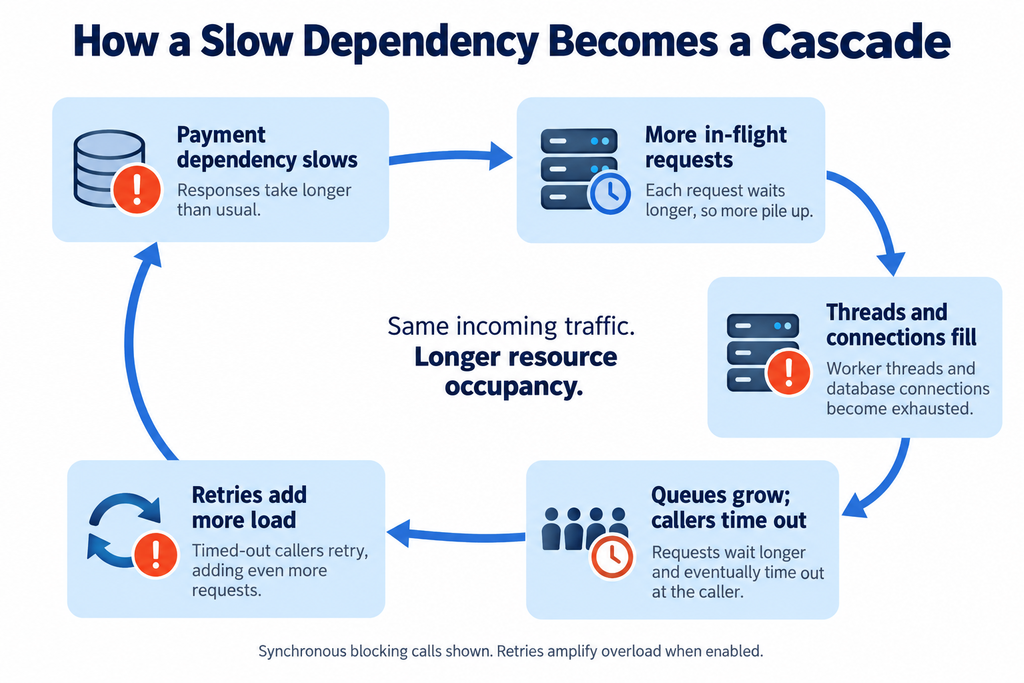
Figure 1. Longer resource occupancy can start a cascade even without an increase in external traffic. Configured retries can amplify the load further.
The next stage is often queueing. New requests wait for workers or connections, so the order service becomes slow even before it reaches the payment call. Gateways and clients may then time out.
If retries are enabled at several layers, one user action can produce multiple downstream attempts. Retrying a payment operation also introduces a correctness problem, because the first attempt may already have succeeded.
I discussed the individual-call side of this problem in designing OpenFeign order APIs around slow dependencies and safe retries. At the service level, the additional question is how much outstanding work one dependency should be allowed to create.
Protect Both Arrival Rate and Outstanding Work
An admission limit protects the system from accepting more work than it can process within a useful time. Its threshold should come from representative load tests and operational observations.
The relevant test is not simply whether an endpoint can return a high number of responses per second. The workload needs to resemble the real request mix, including database access, downstream latency, retries, and background activity.
I would look for the point where latency and queueing begin rising sharply, then leave operating headroom below it. A threshold measured with every instance healthy may also be unsuitable when one instance is unavailable and the remaining instances inherit its traffic.
Every threshold needs a scope. A local limit of 1,000 QPS on each of four instances is not a shared cluster allowance of 1,000 QPS. Distributing the same configuration to all instances does not create a global counter. Uneven traffic distribution can also overload one instance while others remain underused.
Rate limits and concurrency limits answer different questions:
| Protection | Question it answers |
|---|---|
| Request-rate limit | How quickly may new work enter this resource? |
| Concurrency limit | How much work may remain active in this resource? |
| Timeout or deadline | How long may a particular attempt keep waiting? |
For a payment dependency, a concurrency limit is especially useful because it reacts to resource occupancy. When calls slow down, the number of active calls rises even if arrival traffic remains modest.
Sentinel supports QPS and concurrent-thread-count flow control. Its concurrent-thread mode provides lightweight semaphore-style isolation; it does not automatically create a dedicated worker pool for each dependency. Sentinel flow-control documentation
The protected boundary matters. An entry limit around the whole order endpoint controls admitted order traffic. A separate boundary around the payment call controls how much of that traffic may occupy the dependency at once.
Neither boundary automatically isolates every shared resource. HTTP connection-pool limits, bounded executor queues, and database access patterns still need to support the intended separation.
Business priority also needs an implementation. Declaring checkout “more important” than recommendations does not help if recommendation traffic can consume all the same workers or database connections. Separate budgets or appropriate resource isolation make that priority enforceable.
Queueing is not always preferable to rejection. A bounded wait can absorb a brief burst, but holding an interactive request past its useful deadline merely turns an immediate refusal into a delayed failure.
Open the Circuit Without Forgetting the Calls Already Running
A circuit breaker addresses a dependency that has become a poor destination for more work.
Suppose incoming traffic remains within the order service’s admission limit, but payment calls are consistently slow. Continuing to admit calls into that dependency can still consume the service’s concurrency budget.
Sentinel supports circuit breaking based on slow-call ratio, error ratio, or error count. For ratio-based rules, the statistical interval and minimum request volume matter alongside the threshold. A rule should reflect the endpoint’s expected behavior rather than a copied percentage. Sentinel circuit-breaking documentation
A particularly important distinction is that a slow-call threshold is not an HTTP timeout. Classifying a completed call as slow does not, by itself, stop that call when it crosses the threshold.
Likewise, opening a circuit rejects subsequent attempts; it does not automatically cancel requests that are already blocked. Those requests still depend on correctly configured waiting limits and cancellation behavior. Even when the client stops waiting, the remote server may continue processing.
This is why concurrency limits, timeouts, and circuit breaking complement one another. Concurrency limits constrain the initial accumulation, timeouts bound waiting, and the circuit breaker reduces repeated exposure once unhealthy behavior has been observed.
For the order workflow, I would also avoid combining unrelated dependencies into one breaker resource. Payment latency and inventory latency represent different failure domains. A broad resource can make it difficult to identify the unhealthy dependency and may reject operations that do not need it.
Recovery deserves the same attention as opening the circuit. Sentinel Java’s documented half-open behavior permits a probe after the open period; a successful probe closes the circuit. It should not be described as automatic gradual traffic restoration. Admission limits or a separate warm-up strategy must provide controlled recovery where needed. Sentinel half-open behavior
A dependency that has just recovered may still be rebuilding caches or draining internal work. Removing the breaker’s block does not mean every other protection should disappear.
A Fallback Must Preserve What the Business Knows
Once a call is rejected or fails, the application needs to decide what the user can safely do next.
For recommendations, the answer may be simple. The product page can omit that section while continuing to show authoritative product information. The response is less complete, but still useful.
Inventory and payment require stronger boundaries. If inventory reservation cannot be confirmed, the order workflow cannot pretend that stock was reserved. If payment confirmation is unavailable, the application cannot invent a successful payment to keep the response looking healthy.
Two payment situations illustrate the distinction.
In the first, the dependency guard rejects the attempt before it is sent. The service can report that payment initiation is temporarily unavailable. It should not mark the order paid. If this is a retry of an earlier attempt, however, the application must still consult that attempt’s existing state before concluding anything about the overall payment.
In the second, the request has been dispatched and the response is lost or times out. The provider may have processed it. This is an unknown outcome, not proof of failure.
That operation needs an identifiable payment attempt, a pending-confirmation state, and a recovery path through status queries, callbacks, or reconciliation. A retry should follow the provider’s idempotency contract and refer to the same business attempt where appropriate, rather than blindly creating a new charge.
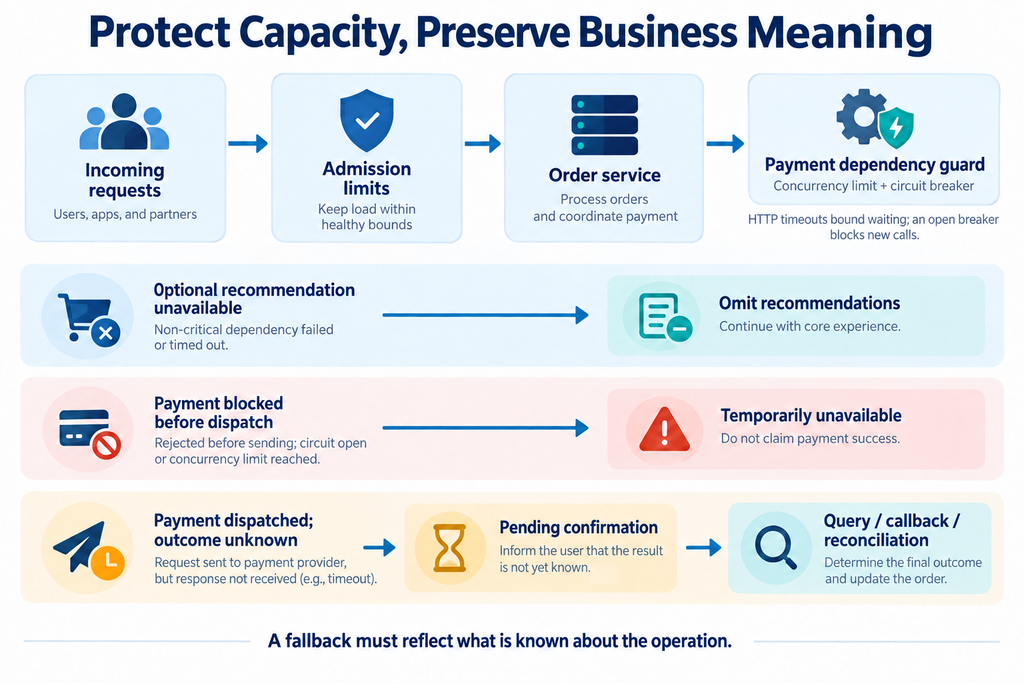
Figure 2. Protection controls resource use; the business workflow determines the safe result. A request blocked before dispatch differs from one whose remote outcome is unknown.
A generic exception handler cannot always infer which situation occurred. A read timeout, a connection failure, and an explicit provider rejection may carry different evidence. The payment integration should preserve that distinction instead of flattening every exception into PAYMENT_FAILED.
This also affects the recovery workload. Status polling must have its own limits and backoff; otherwise, replacing payment calls with unlimited confirmation queries simply creates another overload path.
For Sentinel annotations, the distinction between handlers is useful but narrower than the business decision. When both are configured, blockHandler handles Sentinel rule blocks, while fallback handles eligible exceptions from execution. Neither handler determines the remote payment outcome automatically. Annotation interception and handler signatures must also be configured correctly. Sentinel annotation support
I would keep admission handling close to the protected call, while letting the payment workflow own attempt state and reconciliation. That prevents a convenience fallback from silently changing the meaning of an order.
Degradation can also happen proactively. During an expected traffic peak, optional features can be simplified before a breaker opens. Rate limiting, circuit breaking, and degradation are cooperating controls, not three mandatory stages in a fixed sequence.
Operate the Rules as Part of the Service
Once rules can reject real orders, they belong in production configuration management.
Sentinel’s client executes protection inside the application. The Dashboard provides visibility and management; it is not consulted remotely for every request. Losing Dashboard access therefore does not immediately remove rules already loaded in a running instance.
Persistence is a separate concern. The default Dashboard push updates application memory. Connecting a client to a configuration source does not automatically make every Dashboard edit durable.
For a push-based setup, the intended path is from the management interface to the configuration center, then through the application’s data source into Sentinel. The Dashboard publishing integration must support that path. Sentinel rule persistence and configuration FAQ
Rules should have an owner, a version, a reviewable change history, and a rollback path. A mistaken reduction in the order admission threshold can cause an outage even while every dependency is healthy.
A staged rollout is useful only if the configuration system actually supports targeting the intended instances. It is not enough to call a change “canary” while publishing the same rule to the entire application.
I would also distinguish two failure cases: an existing instance losing access to the configuration center, and a new instance starting while that center is unavailable. Retaining an already loaded rule does not answer how a fresh process obtains its initial protection.
Monitoring needs to show business effects alongside framework metrics. A fast rejection can improve measured response time while reducing completed orders. Similarly, a fallback may return HTTP 200 while leaving an optional feature unavailable or a payment awaiting confirmation.
Useful views connect admitted traffic, rejected traffic, active dependency calls, pool occupancy, timeout rates, breaker transitions, and the age of pending payment attempts. A successful protection rule should preserve useful work, not merely make a latency chart look better.
Before relying on the design, I would exercise a small set of failure scenarios:
| Scenario | Expected behavior |
|---|---|
| Payment becomes slow while traffic remains steady | Dependency concurrency remains bounded; unrelated operations retain capacity. |
| The breaker opens with calls already active | New calls are blocked; existing calls end through their own waiting limits. |
| A payment response is lost after dispatch | The attempt remains identifiable and is reconciled without a duplicate charge. |
| The dependency recovers | Probe behavior is correct, and admission controls prevent an uncontrolled surge. |
| A rule is misconfigured or configuration access fails | Operators can identify the applied version, roll back, and verify startup behavior. |
Run a small failure drill before tuning production rules
A repeatable drill gives the rules a meaning that a copied threshold cannot provide:
- Hold the payment endpoint for two seconds while sending a fixed request rate.
- Record active calls, rejected calls, queue length, connection usage, and timeout outcomes.
- Release the dependency and check that half-open probes recover without a traffic surge.
- Verify that a timed-out payment remains identifiable and is reconciled without a duplicate charge.
The test should run with the same retry and connection-pool settings used by the service. Otherwise the result only describes the test harness, not the failure boundary the application will operate.
The purpose of these controls is to make overload and dependency failure produce understandable outcomes. Some requests will be rejected. Some optional features will disappear temporarily. Some payment attempts will need confirmation before the customer sees a final result.
Those outcomes are manageable when they are explicit. What I want to avoid is a service that accepts everything, exhausts its shared resources, and then loses the ability to complete even the work it could otherwise have handled.
For an order service, a good protection boundary has two parts: a limit on the resources an operation may consume, and an honest statement of what is known about its result. Sentinel helps enforce the first. The business workflow must preserve the second.